
Veneers, Bonding, or Whitening: Which Fits Your Goals?
Veneers vs bonding vs whitening, compared by what each changes, how long it lasts and how much natural tooth it uses, so you can plan a smile built to last.
A chipped front tooth you notice in every photo, or a smile that years of coffee have slowly dulled, can leave you wanting a change without knowing which kind. Here is the short answer to veneers vs bonding vs whitening: whitening changes color only, bonding reshapes or repairs a small area, and veneers change the color, shape and alignment of several teeth at once. How long each lasts, and how much of your natural tooth it involves, decides the rest.
At SMILES ON 35th in Seattle, Dr. Rubecca Shahid works through that choice with you in a smile design consultation, starting with what you’d like to change and what your exam shows. This guide lays out the trade-offs, so you arrive with a clear question and leave with clear choices.
What is the difference between veneers, bonding and whitening?
Each treatment changes something different. Whitening lightens the color of your natural teeth. Bonding adds tooth-colored material to repair or reshape a small area. Veneers cover the front of several teeth to change their color, their shape and how evenly they appear to line up.
| Whitening | Bonding | Veneers | |
|---|---|---|---|
| What it changes | Color only | A chip, a small gap or an edge | Color, shape and alignment across several teeth |
| Natural tooth removed | None | Little or none | Composite: little or none. Porcelain: a thin layer of enamel |
| Typical visits | One in-office visit, or trays at home | One | Composite: often one longer visit. Porcelain: two to three |
| How long it lasts | A year or more, with touch-ups | Several years, often much longer | Porcelain lasts longest; composite is easy to repair |
Whitening uses a professional gel to lighten stains on and within the tooth. As you age, enamel, the hard outer layer of the tooth, grows thinner and lets the yellower layer beneath it show through, according to the American Dental Association. Lifting that color can bring back the brighter shade you remember. At SMILES ON 35th, you can choose in-office whitening with Zoom or KöR, custom take-home trays, or both. Whitening can’t change a tooth’s shape or rebuild a chip.
Dental bonding is tooth-colored composite resin, a putty-like material that is shaped by hand onto the tooth, hardened with a light and polished to blend in. It suits a single chip, a small gap or an edge that is a little short or uneven. Dental bonding is usually finished in one visit, often without numbing.
Veneers are thin shells bonded to the front of the teeth. Composite veneers use the same material as bonding, layered across the whole front surface. Porcelain veneers are made from ceramic, which holds its shine and resists stains. Either kind can reshape and recolor several teeth together, which suits a bigger change. SMILES ON 35th offers porcelain and composite veneers, as well as 3D-printed veneers that sit between the two.
Is bonding better than veneers?
Neither is better across the board. Bonding is usually the better choice for a small fix on one or two teeth. Veneers are usually better when you want to change several teeth at once, or want the most durable, stain-resistant surface.
The real trade-off is between how much changes, how long it lasts and how much natural tooth it involves:
- Bonding keeps nearly all of your enamel, costs less and can be touched up in a single visit. Composite can pick up stains and wear at the edges over the years, so it asks for a little more upkeep.
- Composite veneers cover more of each tooth for a bigger change, while still needing little or no removal of tooth. Like bonding, they can be repaired rather than replaced.
- Porcelain veneers usually involve removing a thin layer of enamel so the veneer sits naturally. In return, porcelain holds its color and gloss and typically lasts longest.
Enamel doesn’t grow back, so a good plan keeps any preparation to a minimum, and some designs need none at all. Keeping healthy tooth matters beyond appearance: the enamel you keep stays strong and gives any future work a better surface to bond to.
Choosing bonding today also leaves your options open. Because it leaves the tooth almost untouched, bonding is a conservative place to start if you are unsure how far you want to go.
Should I whiten my teeth before veneers or bonding?
Yes. If you want whiter teeth and you’re also planning bonding or veneers, whiten first. Bonding and veneers are color-matched to your teeth on the day they’re made, and they don’t whiten afterward. The ADA notes that only natural teeth respond to whitening, so tooth-colored work can end up a different shade from the teeth around it.
Whiten first, and your bonding or veneers are matched to the brighter shade you chose. Whiten afterward, and your natural teeth lighten while the new work stays the same color, which can mean redoing it to match. The same ADA summary notes that whitening may affect how well bonding materials grip enamel, so the timing between the two steps is part of your plan.
Whitening first can also shrink the plan. Once your teeth are brighter, a single chip may be the only thing left that bothers you, and bonding one tooth may be all you need. If color was your main concern, whitening alone may be the whole answer.
How long do veneers and bonding last?
Porcelain veneers typically last longest. Composite veneers and bonding last several years and are easy to repair, and whitening lasts a year or more with touch-ups. Your bite and daily care affect all of them.
- Porcelain veneers. A systematic review of clinical studies found about 89% of porcelain veneers still in place after a median of nine years. Chipping or fracture was the most common problem.
- Composite veneers. A 2023 review of studies that followed patients for roughly two to eight years found about 88% of composite veneers still in service. Surface roughness, color mismatch and staining at the edges were the most common issues, and most were judged acceptable with or without a small repair.
- Dental bonding. Bonding lasts several years with good care, and often much longer. In a review of clinical trials, about 90% of composite repairs to the broken corner or edge of a front tooth had not needed replacing after 10 years. Fracture was the main reason the rest were redone.
- Whitening. Results often last a year or more, depending on what you eat and drink. Custom trays make occasional touch-ups easy.
Notice what these numbers share: chips and fractures top the list. That is why your bite matters as much as the material you choose.
Why check gums and bite first?
Cosmetic work lasts longest on healthy gums and a stable bite, so Dr. Shahid checks both before designing anything. Veneers or bonding placed on inflamed gums or an uneven bite are more likely to chip, stain at the edges or come loose.
As a new patient, your first visit includes a comprehensive assessment of your gums, teeth, bite and smile to catch issues early on. Dr. Shahid trained in this assessment at the Kois Center in Seattle, and it looks at how your teeth, gums and lips work together with your face, which shapes any cosmetic design. When your bite needs a closer look, T-Scan digital bite analysis gives a digital map of how your teeth meet, showing where veneers or bonding would take the most force. If you clench through heavy lifts or wake with a tired jaw, that matters to your new smile as much as the material does, and a night guard can protect the result while you sleep.
Any gum or bite problem is addressed first. Wanting a smile you love is a good reason to come in, and the order simply protects that result.
Which option is right for you?
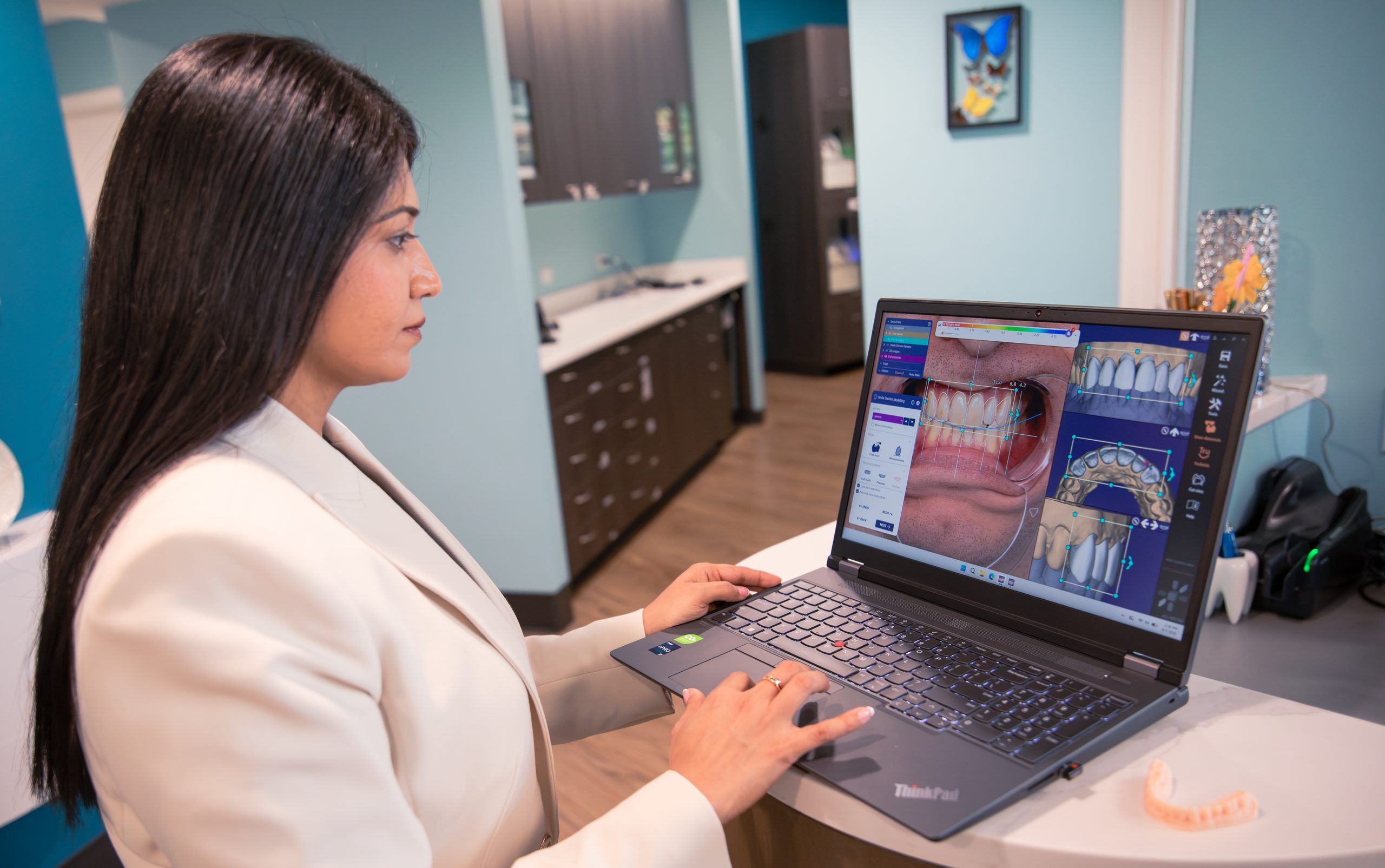
The right choice depends on your goals and what your exam finds, and you work it out together with Dr. Shahid. In a smile design consultation, she photographs your smile, checks your teeth, gums and bite, and asks what you would like to change. For veneers, you preview the design before treatment begins and refine it until it feels like you. She starts with the most conservative option that delivers the result you want.
Dr. Shahid is a member of the American Academy of Cosmetic Dentistry and has trained in both composite and porcelain veneers, so her recommendation follows your goals rather than a single favorite technique. You get the reasoning behind each option, with no judgment and no pressure.
A few questions will make that conversation clearer:
- What bothers you most: the color, a chip, a gap or the shape of several teeth?
- How long do you want the result to last, and how do you feel about occasional touch-ups?
- How much of your natural tooth are you comfortable changing?
- Do you clench or grind your teeth?
Whitening, bonding and veneers each solve a different problem, and knowing which one is yours is the first step toward a smile you’re proud of. Explore Smile Design at SMILES ON 35th, then book a smile design consultation to see which option fits you.
More questions about veneers, bonding and whitening
Yes, but only your natural teeth will lighten. Existing veneers, bonding, crowns and tooth-colored fillings keep the color they were made in.
If any of that work shows when you smile, Dr. Rubecca Shahid plans around it before you whiten, so your finished smile matches from tooth to tooth.
Yes. A check of your teeth and gums comes first, because whitening over a cavity, a crack or inflamed gums can cause discomfort and an uneven result.
The exam also shows what is causing the discoloration, which tells you whether whitening alone can reach the shade you want or whether bonding or veneers would serve you better.
The cost depends on the treatment, the material and how many teeth are involved, so it is set after your smile design consultation. Bonding and composite veneers generally cost less than porcelain veneers.
Pricing at SMILES ON 35th is transparent and specific to your plan. You see the full cost before treatment begins, and flexible payment options, including monthly financing, let you spread it out.
About the author
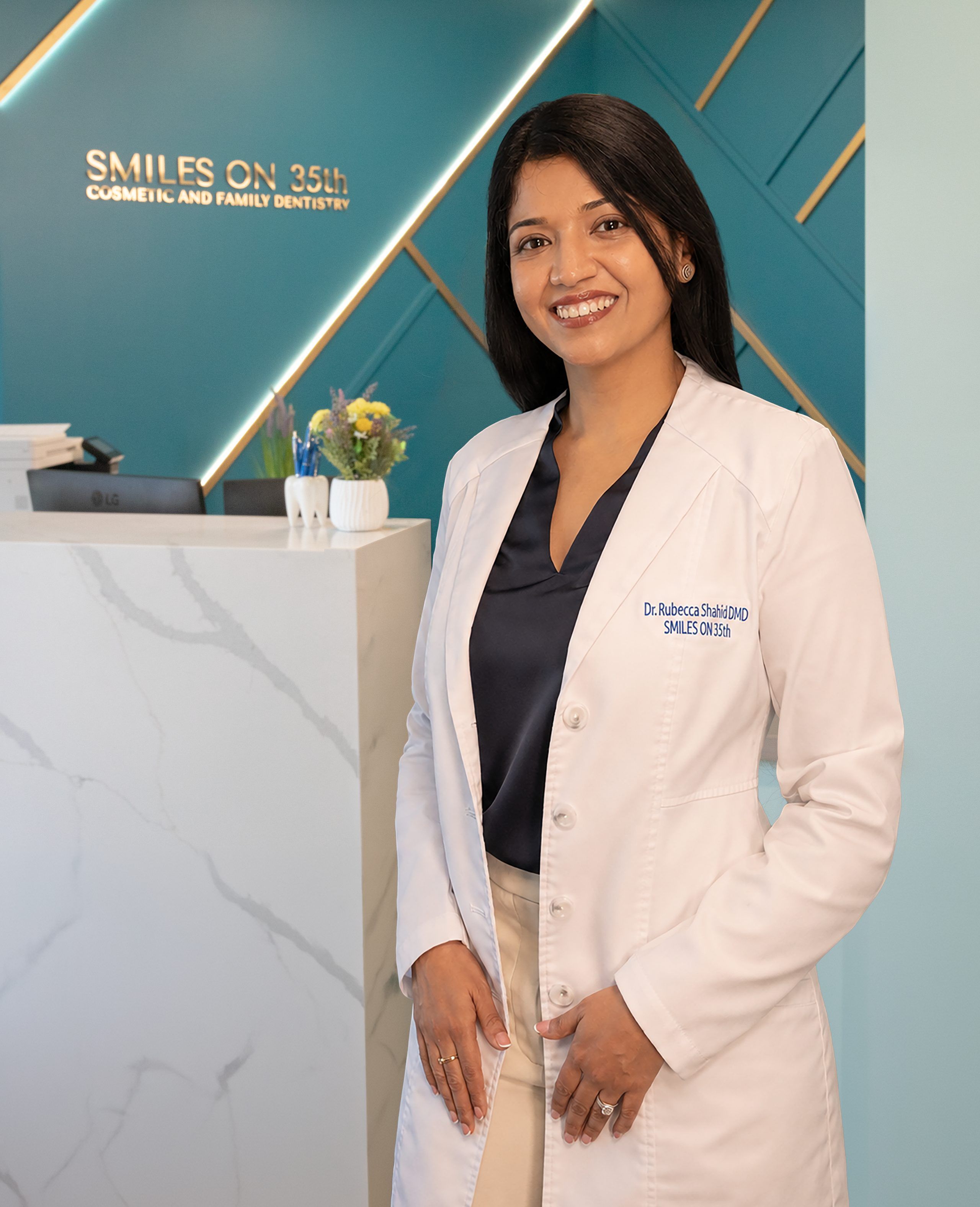
Dr. Rubecca Shahid, DMD
Dentist
Dr. Shahid practices longevity dentistry at SMILES ON 35th, her independent, woman-owned practice in Seattle where every plan starts with a diagnosis of your teeth, gums, bite, and airway. A graduate of the University of Illinois at Chicago College of Dentistry and Seattle's Kois Center, she holds a Mastership in biomimetic dentistry from the Alleman Center and completes nearly eight times the continuing education Washington requires each year.
She is a member of the ADA, AGD, AACD, AADSM, WSDA, and Seattle Study Club, and writes these articles so you can understand what is happening in your mouth and make informed decisions for your long-term health.
Meet Dr. Shahid