
What a Dental Saliva Test Reveals About Your Mouth
A dental saliva test shows which bacteria drive gum disease and cavities, so your care targets your results. See what it reveals, and what it can't.
A dental saliva test is a quick, painless sample that shows which bacteria are at work in your mouth and how well your saliva protects your teeth. It measures your risk for gum disease and cavities, and what is driving that risk. It does not diagnose disease on its own. At SMILES ON 35th in Seattle, Dr. Rubecca Shahid reads your results alongside your exam and X-rays, then builds treatment around what the test finds.
If you brush and floss faithfully and still hear about bleeding gums or another cavity, a saliva test is often where the explanation starts. It turns “keep doing your best” into a finding you can see and act on.
What is a dental saliva test?
A dental saliva test analyzes a small sample of your saliva for the bacteria and conditions behind gum disease and tooth decay. You swish a small amount of rinse for a moment and spit it into a tube. It takes a few minutes, with no needles and no discomfort.
Using saliva this way is called salivary diagnostics. Your mouth is home to a large community of bacteria, known together as the oral microbiome. Most of them are harmless. A few are closely tied to disease, and the mix differs from person to person. Saliva carries a sample of that community, which makes it a simple window into what is happening around your teeth and gums.
What can a saliva test tell you about your teeth and gums?
A saliva test can show three things: which gum disease bacteria are present, which cavity-causing bacteria you carry and how active they are, and how well your saliva defends your teeth. Each one points to a different part of your care.
Gum disease bacteria
Gum disease is chronic inflammation of the gums and the bone that holds your teeth in place, and a group of bacteria called periodontal pathogens drives it. The most studied is Porphyromonas gingivalis. Researchers describe it as a keystone pathogen because, even in small numbers, it can push a normally harmless bacterial community toward one that fuels inflammation. Other bacteria, such as Tannerella forsythia and Treponema denticola, are frequent targets of testing too. An oral bacteria test shows which of these you carry and how much of each, which tells Dr. Shahid which treatment is most likely to help.
Cavity bacteria
Tooth decay starts when bacteria turn sugars and starches into acid that pulls minerals out of your enamel. Streptococcus mutans is the best-known culprit: it thrives on sugar and keeps making acid even when your mouth is already acidic. A high level signals a higher risk of new decay, which gives you the chance to act before more damage is done.
How well your saliva protects your teeth
Saliva is your teeth’s own defense. It neutralizes acid, washes food away, and carries calcium and phosphate that keep teeth strong and fight decay. A saliva test can also show how acidic your saliva is, known as salivary pH, and whether you make enough of it. Hundreds of medicines, including common ones for blood pressure and depression, can reduce saliva, and severe dry mouth is one of the factors the American Dental Association lists for high cavity risk.
Combined with your exam, your history, and your eating habits, these results form a cavity risk assessment: a clear picture of how likely new decay is, and why.
Is a saliva test for gum disease accurate?
A saliva test for gum disease is good at detecting the bacteria linked to it, but it measures risk rather than diagnosing the disease by itself. In a 2025 review that pooled studies of saliva samples, P. gingivalis correctly identified about 84% of people with periodontitis, the advanced form of gum disease, and about 85% of people without it.
Gum disease is diagnosed in the chair, by measuring how much gum and bone attachment has been lost around each tooth with a gentle probe, supported by X-rays. The exam shows the damage that is already there. The saliva test adds what the exam cannot see: which bacteria are driving it. Dr. Shahid uses both, and reading those risks together is central to her training as a Kois Center graduate, a program built on comprehensive diagnosis and risk assessment.
Do I need a saliva test if I brush and floss well?
Not always, but good habits don’t rule out risk. Brushing and flossing remove plaque, yet the bacteria you carry, the quality of your saliva, dry mouth, and how often you snack or sip all affect your gums and teeth. Gum disease can become serious before you notice symptoms, and early decay usually causes none.
A saliva test is most useful when:
- Your gums bleed or are pulling back despite careful home care.
- Cavities keep appearing even though you brush and floss.
- You’ve been told you need a deep cleaning and want to know why.
- You want a baseline: a first result that future visits can be measured against, even when nothing hurts.
If your exam shows healthy gums and no new decay, you may not need one, and Dr. Shahid will tell you that plainly. Frequent cavities or bleeding gums aren’t a personal failing, either. They usually have a measurable cause, and finding it comes with no judgment and no lecture.
How results shape your treatment
Your results decide which treatments, prescriptions, and home-care products are recommended, so care targets the bacteria you actually have. Dr. Shahid walks you through them in plain language, then builds a plan with you, step by step.
- Gum disease bacteria: gum disease treatment is matched to what the test found. Depending on your case, that includes prescriptions and rinses targeted to your results, a deep cleaning below the gumline, CO2 laser therapy for less bleeding and faster healing, and custom Perio Protect trays that hold medication against your gums at home.
- High cavity risk: our cavity prevention protocol pairs professional fluoride with CariFree take-home products and practical coaching on diet and hygiene, so your daily routine works with your treatment.
- An early cavity: Curodont, a gel that helps an early cavity rebuild its own enamel, can often treat it with no drill and no numbing. If you’re wondering whether an early cavity can heal, that article explains when it’s possible.
Two people with the same bleeding gums may need different medication, because the bacteria behind the bleeding differ. A plan built from your own results fits your mouth rather than an average one.
Why retesting matters
A follow-up saliva test shows whether treatment worked. If you’ve ever retested ApoB or HbA1c after changing your diet, you already know the logic: the second number tells you whether the change is real. A dental retest does the same for the bacteria in your mouth. It guides your next steps and how often you need check-ups, and if levels haven’t improved, Dr. Shahid adjusts the treatment rather than repeating what didn’t work.
What blood testing adds
A blood test looks for inflammation and nutritional gaps that a saliva sample cannot show. Saliva tells you what is happening in your mouth; blood shows how your body is handling inflammation, and whether shortfalls in nutrition could be affecting your gums and overall health.
That matters because gum disease is chronic inflammation, and research associates it with heart disease, even though it has not been shown to cause it. Dr. Shahid’s training includes periodontal medicine and inflammatory risk, so she reads your mouth and your markers together. Nutritional counseling is based on your own results, and when findings point beyond your mouth, we work with your physician, or one from our network.
Where to start
A dental saliva test doesn’t replace an exam; it completes one. Together they show what is happening, why, and whether treatment is working, so risk is caught before it becomes damage and progress is something you can measure. At SMILES ON 35th, the test is part of your visit rather than something to arrange elsewhere, and Dr. Shahid reviews every result with you before you decide on care. Learn more about salivary testing at our office, then book a comprehensive exam to see where your gums and teeth stand today.
About the author
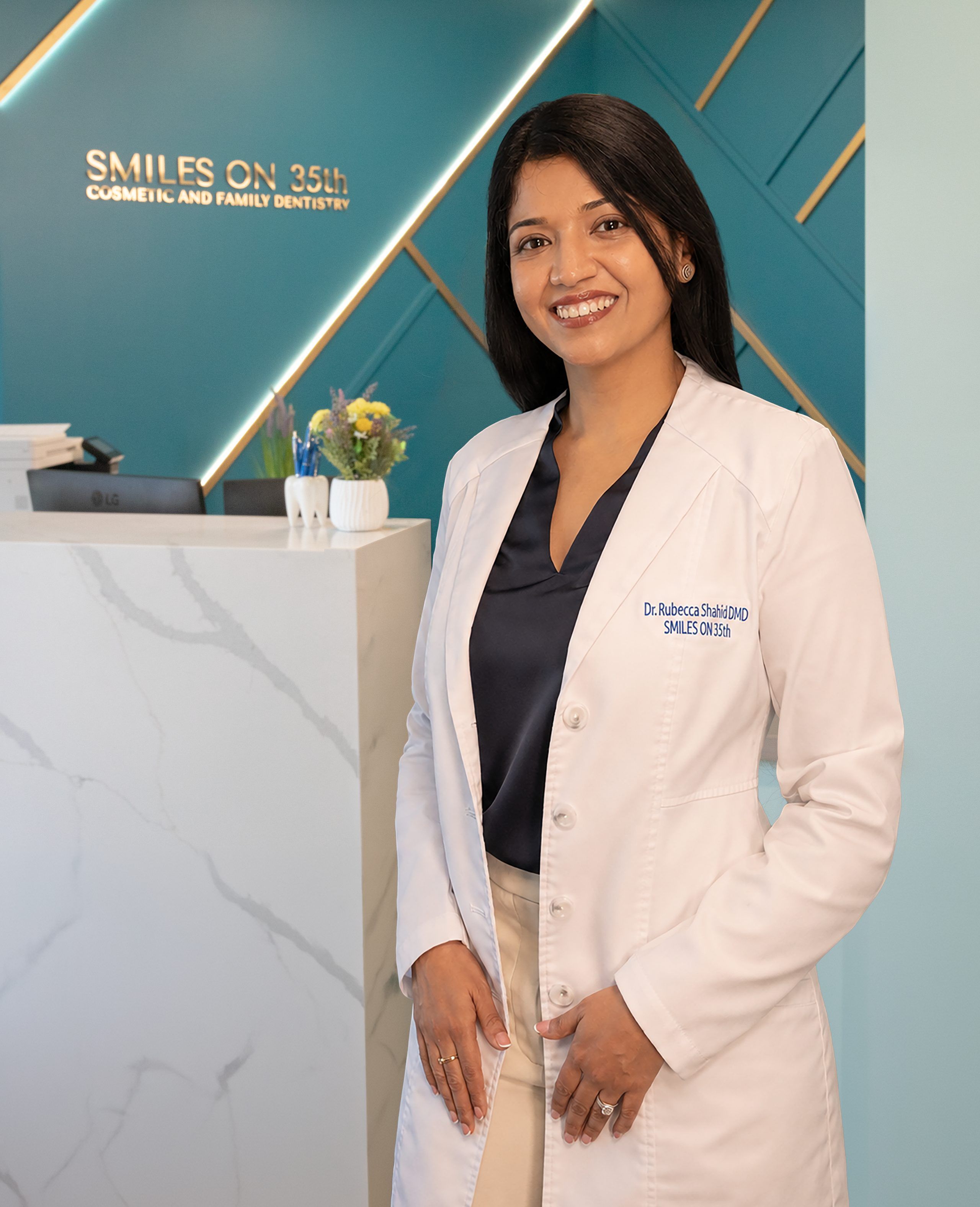
Dr. Rubecca Shahid, DMD
Dentist
Dr. Shahid practices longevity dentistry at SMILES ON 35th, her independent, woman-owned practice in Seattle where every plan starts with a diagnosis of your teeth, gums, bite, and airway. A graduate of the University of Illinois at Chicago College of Dentistry and Seattle's Kois Center, she holds a Mastership in biomimetic dentistry from the Alleman Center and completes nearly eight times the continuing education Washington requires each year.
She is a member of the ADA, AGD, AACD, AADSM, WSDA, and Seattle Study Club, and writes these articles so you can understand what is happening in your mouth and make informed decisions for your long-term health.
Meet Dr. Shahid